
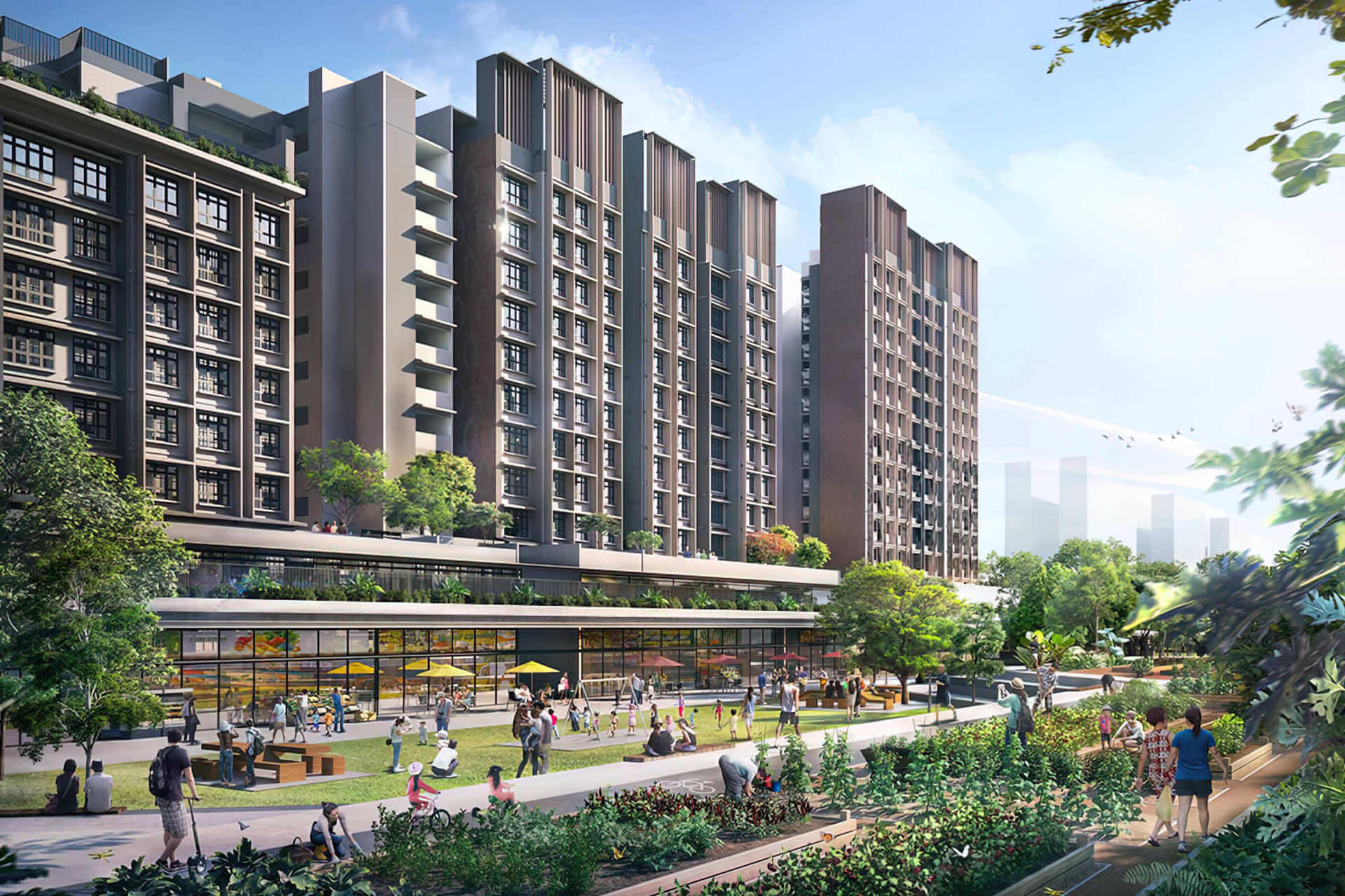
As Singapore advances toward a decentralised urban model, property value in 2026 is increasingly shaped by mobility efficiency and lifestyle precision rather than mere proximity to the CBD. The government’s long-term commitment to a “45-minute city” has placed renewed emphasis on developments that reduce travel friction while enhancing daily liveability. Two projects exemplify how this vision is unfolding across different regions of the island: Tengah Garden Residences in the West and Vela Bay along the eastern coastline. Each represents a distinct interpretation of future-ready living—one driven by town-scale mobility planning, the other by high-spec private design within a prime coastal address.
Redefining Daily Travel: Commute Convenience in Tengah
Tengah is Singapore’s first town planned with smart mobility embedded at its foundation, and Tengah Garden Residences benefits directly from this ground-up approach. The commute convenience Tengah offers is anchored by the Jurong Region Line (JRL), which will connect residents seamlessly to key employment nodes such as Jurong Innovation District and Jurong Lake District. Unlike legacy estates retrofitted with transport solutions, Tengah’s rail and road networks were conceived simultaneously with residential planning, allowing for smoother traffic distribution and pedestrian prioritisation.
Beyond rail connectivity, Tengah’s car-lite design significantly alters the commuting experience. Vehicular traffic is largely routed underground, freeing surface areas for shaded walkways and cycling paths that link homes directly to MRT stations and neighbourhood amenities. This transforms the often-overlooked “first and last mile” into a pleasant, low-stress transition. For working professionals and families alike, time saved on daily travel translates into higher quality of life—an increasingly important factor influencing buyer demand and tenant retention.
Mobility as an Investment Multiplier
From an investor’s perspective, efficient connectivity is more than a lifestyle perk; it is a value multiplier. Estates with strong transport integration consistently demonstrate stronger price resilience during market cycles. Tengah’s positioning near emerging commercial zones adds another layer of upside. As the Jurong Innovation District matures into a global hub for advanced manufacturing and research, demand for nearby housing is expected to rise in tandem. The commute convenience Tengah delivers positions developments within the town to capture this spillover demand, supporting both rental growth and long-term capital appreciation.
Additionally, the planned relocation of Anglo-Chinese School (Primary) to Tengah by the end of the decade introduces a powerful family-driven demand catalyst. When combined with efficient transport links, this creates a balanced buyer pool of owner-occupiers and tenants, reducing volatility and enhancing asset stability.
Coastal Precision: Inside the Vela Bay Condo Features
On the opposite end of the island, Vela Bay represents a different but equally compelling proposition. Situated within the Bayshore precinct, the development leverages proximity to the Thomson–East Coast Line to deliver swift access to the city while preserving the exclusivity of a coastal enclave. The Vela Bay condo features are designed to appeal to buyers who prioritise refinement, automation, and architectural clarity within a limited-supply location.
Residences are equipped with integrated smart-home systems that manage climate control, lighting, and security through centralised interfaces. This level of automation not only enhances daily comfort but also appeals to a tech-savvy tenant demographic willing to pay a premium for convenience. The building’s orientation and façade design maximise natural ventilation and sea views, reinforcing its positioning as a lifestyle-led asset rather than a purely utilitarian one.
The Bayshore Advantage and Urban Liquidity
Bayshore’s transformation into a lifestyle destination is supported by URA planning that emphasises pedestrian connectivity, green corridors, and direct links between MRT stations and East Coast Park. This enhances the intrinsic value of developments like Vela Bay by embedding them within a broader leisure ecosystem. Properties in such environments tend to enjoy higher liquidity, as they appeal to both local upgraders and expatriates seeking proximity to recreation without sacrificing accessibility.
The Vela Bay condo features also align with shifting post-pandemic preferences, where private outdoor spaces, wellness amenities, and lower-density living are increasingly sought after. These characteristics strengthen rental demand while future-proofing the development against changing lifestyle expectations.
Contrasting Lifestyles, Complementary Strategies
Choosing between Tengah Garden Residences and Vela Bay ultimately comes down to strategic alignment rather than comparison. Tengah appeals to buyers focused on growth trajectories—those willing to enter an emerging town early to benefit from infrastructure-led appreciation. Its appeal lies in scale, planning foresight, and the long-term dividends of smart mobility.
Vela Bay, by contrast, caters to those seeking immediate prestige and scarcity value. Coastal developments with strong transport access are inherently limited, and this rarity underpins pricing strength even during broader market recalibrations. For portfolio builders, these two projects can serve complementary roles: one as a growth-oriented asset, the other as a stabilising, income-generating anchor.
Conclusion: Investing Where Connectivity Meets Vision
As Singapore’s real estate market matures, successful property decisions increasingly hinge on how well a development integrates mobility, lifestyle, and future infrastructure. Tengah Garden Residences exemplifies how commute convenience can be engineered at a town level to unlock long-term value, while Vela Bay demonstrates how meticulous design and location scarcity can elevate everyday living into a premium proposition. Both developments are aligned with national planning priorities and shifting buyer expectations, making them credible contenders for investors and homeowners looking ahead to the next decade. The opportunity lies in recognising how different forms of connectivity—whether forest-linked pathways or coastal rail access—translate into enduring real estate performance.